







Brand relationship disclosure: OWNSTRAND and Vit So are sister brands under the same owner. This article provides selection guidance, not an independent review or product test. Confirm styles, supply and visit arrangements with OWNSTRAND.
Grey wig colour at different lengths: choose the pattern first
Start by deciding what you mean by a consistent mix. You might want scattered pale strands from the fringe through the ends, or a brighter face with a darker back. Those are different briefs, even if both are called grey. A short fringe puts its visible strands close to the face, while a longer back gives you a larger area to judge. Compare each area's appearance rather than expecting one small swatch to explain the whole style.
OWNSTRAND's guide to grey wigs is a useful starting point for a standard mix. It distinguishes grey, silver, white and salt-and-pepper descriptions, while explaining that the latter does not specify a fixed percentage. Ask for the exact style and shade reference you are considering. A category photograph can suggest a direction, but it does not confirm that the same distribution appears in another length or that a particular option is available.
If the vocabulary is unclear, the guide to salt and pepper hair colour can help you describe the contrast you like. Then be more specific about the wig: should darker strands remain clearly visible at the fringe, and should the ends still read as mixed? Keep a rooted effect separate from this request. Dark roots with pale lengths are not the same visual pattern as light and dark strands appearing together throughout a cut.

Describe salt and pepper wig shade distribution by area
Use a four-zone comparison: front, part and crown, side layers, then back and ends. This is a practical way to organise your observations, not a laboratory assessment of colour. In each zone, note whether dark hair leads, light hair leads, or both remain distinct. Also note whether the pale strands look finely scattered or grouped into a visible streak. These descriptions reveal differences that an overall grey percentage might leave unresolved.
For a more particular mix, OWNSTRAND's custom wig with a percentage of grey hair page invites discussion of grey prominence and where its effect matters. Ask whether your preferred distribution can be considered across the intended short front and longer back. The page treats achievable proportions and references as case-by-case matters. Do not translate a number into a promise that every zone will contain that proportion, or that strand placement can exactly reproduce a photograph.
For example, your brief might say, 'Keep the fringe dark enough to show individual silver strands, soften the part, and carry some silver into the longer back without making the ends white.' This is a hypothetical preference, not an available recipe. Add the change you would dislike most, such as a pale fringe above an unexpectedly dark back. That gives the supplier something concrete to discuss before you become attached to an unconfirmed number.
A percentage needs an explanation
If a percentage is proposed, ask what it describes: the whole blend, a particular area, or a reference sample. Ask whether placement can be discussed separately and how the result will be assessed. A photograph cannot reliably reveal a numerical proportion, so avoid counting bright pixels as grey strands. Keep your visual description alongside any suggested number; the description is what explains why the number matters to you.
Compare short and long references under similar light
The American Cancer Society recommends comparing hair and wig swatches in natural light, outdoors or near a window.[1] Use that advice as the starting condition for your comparison. Look at the references together rather than comparing a warm indoor image of the fringe with an outdoor image of the back. Natural light helps, but it does not turn a screen into a precise colour standard or establish that two differently photographed styles share an identical blend.
Request views that actually show the proposed lengths: a front view with the fringe in place, the everyday part, a side view and the full back. If only a small swatch exists, ask what it can demonstrate and what remains unknown. A sample may help explain tone and contrast without showing how the final layers will fall. Identify that gap explicitly instead of silently assuming the short and long areas will look alike.
Bring your own reference photographs where possible. Cancer Research UK notes that photographs can help a wig fitter understand a previous hairstyle.[2] For this decision, include the longer back rather than only a favourite portrait. Keep filters off and use a similar distance for each view. Photographs remain discussion aids, not manufacturing guarantees; they are most useful when accompanied by a sentence explaining which area you want to keep light, dark or mixed.
Separate reflection from placement
When one patch looks unusually pale, change the viewing angle before deciding the distribution is wrong. Check whether the same strands stay visibly light or whether a bright highlight moves with the light. Then compare the area at normal mirror distance. You are deciding how the hairstyle reads in everyday use, not whether one close-up contains a bright stripe. Ask for clarification if reflections make a supplied image hard to interpret.
Check the mix with the intended layers and part
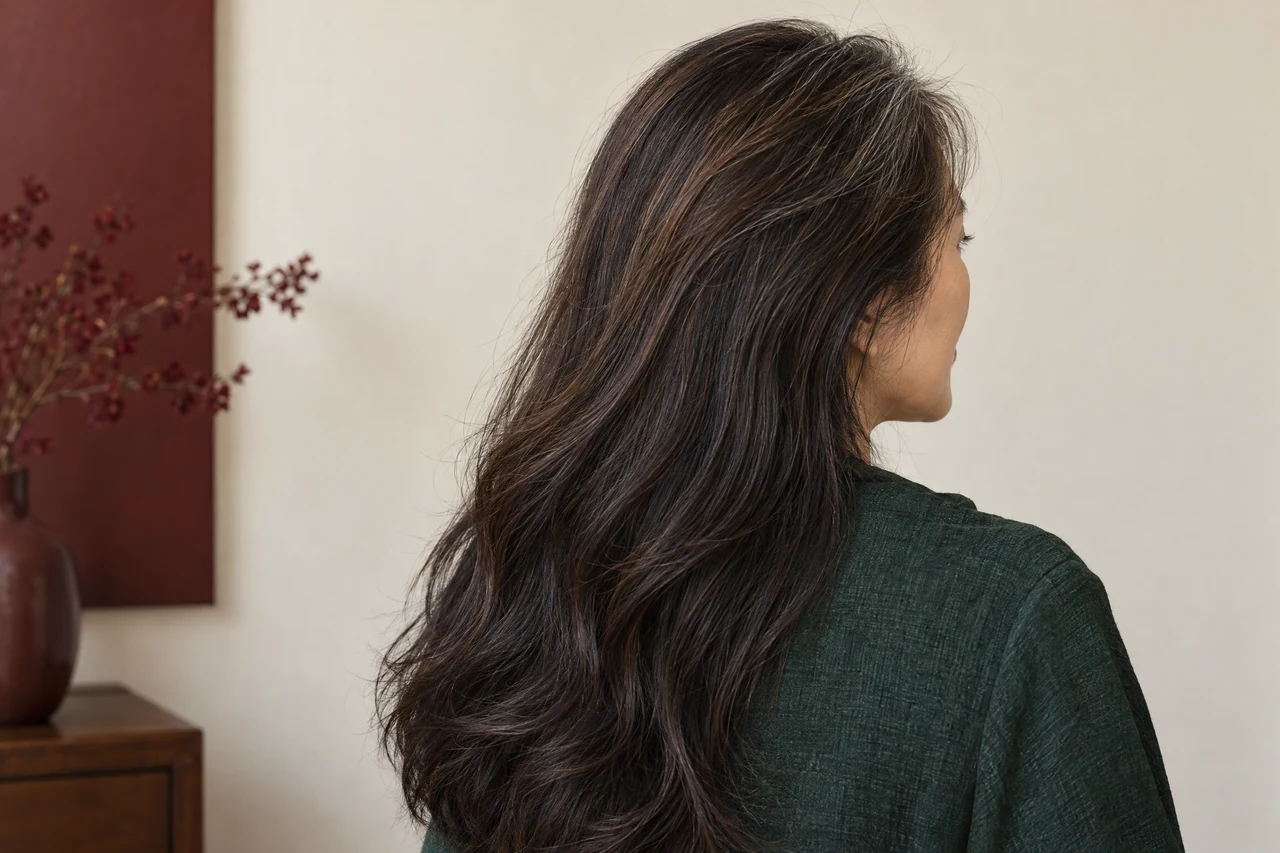
Colour inspection should use the style you intend to wear. A long sample swept behind the ears does not show what a short fringe will reveal. Ask which references resemble the planned cut and whether changing the part exposes a different balance. Layers can overlap and cover strands that were visible when the hair was spread out. Treat these as reasons to inspect the finished outline, not as a rule that longer hair must look darker or lighter.
Check the back with a second mirror or an agreed photograph, then gently turn your head if trying a piece on. Notice whether side layers blend into the back or leave a contrast you did not request. If you plan to tuck the sides behind your ears, compare that position too. A brighter front with a darker back can be intentional and attractive; the concern is whether it matches your brief, not whether every view has equal brightness.
The wider guide to how to make a wig look natural puts colour alongside the overall outline. Here, keep those questions separate enough to solve them: an overly full side may need a shape discussion, while missing silver through the back is a colour-reference issue. Ask what a proposed trim would change before cutting. Removing length cannot be assumed to redistribute grey strands or correct a mix that was wrong from the outset.
Choose standard shade or custom enquiry for the right reason
A standard shade is worth considering when the available reference already shows a mix you like across the intended lengths and you accept some variation. A custom discussion is more useful when a particular distribution is central to the look, or when the planned short front and long back differ substantially from the available example. Neither route wins automatically. Cancer Research UK cautions that a more expensive wig does not necessarily look more real.[2] Judge the evidence for your preference.
For feasibility and quotation questions, OWNSTRAND's custom human hair wig Hong Kong overview describes sample viewing, head measurement, handmade production and a return fitting with washing, cutting and blow-drying. Ask how your length plan and grey placement would be handled within that process. Confirm the individual construction, fibre details, available references, price and completion arrangements. The service description does not establish that a particular combination is possible or that your reference can be copied exactly.
Before enquiring, use the discussion of custom made wigs to separate your priorities. You might be flexible about the exact back length but not about a silver streak near the face. Or you might prefer evenly scattered grey more than a precise percentage. Name that trade-off. If the desired distribution cannot be confirmed, compare an acceptable standard reference or revise the brief rather than assuming custom work removes every limitation.

Confirm the brief before cutting or changing colour
End the selection conversation with a short written description of the retained base colour, grey prominence, placement and intended lengths. Ask which sample or photograph represents each choice and what variations you should expect. Before any irreversible trim, confirm how the fringe, side layers and longer back relate to that agreement. If the available evidence leaves the ends unclear, keep that question open; an unanswered detail is not a reason to invent confidence in the final mix.
Do not plan to fix an uncertain distribution yourself with dye or heat. The American Cancer Society advises against a colour rinse on a synthetic wig and against heat tools unless the wig is heat resistant.[1] Ask for instructions for the exact piece, including any blended fibres and processing limits. If wearing needs involve scalp symptoms or treatment, seek advice from a care professional separately from this cosmetic colour discussion. Appearance guidance cannot establish medical suitability.
Four situations that change the standard-shade versus custom decision
| What you observe | Standard shade may suit | Custom question to ask |
|---|---|---|
| Fine grey scattering from fringe to ends | The same-style reference shows the desired continuity | Can that fine scattering be discussed at both lengths? |
| Silver near the face, darker long back | That contrast is intentional and clearly shown | Which areas can have different grey prominence? |
| Small swatch only, no full back view | Wait for better evidence before choosing | What reference can show the longer back? |
| Proposed cut differs from the sample | You accept the uncertainty and visible differences | How will the planned layers affect the visible mix? |
Your preparation checklist
- Name the dark base tone you want to retain.
- Describe grey prominence in the four zones: front, part/crown, sides and back/ends.
- Compare the relevant references together under similar natural light.
- Check the everyday part and the full outline at normal mirror distance.
- Record the most important placement and the variation you would accept.
- Confirm feasibility, fibre details, quotation and fitting arrangements before deciding.
Frequently asked questions
Will the same grey shade look identical on a fringe and a long back?
Not necessarily. The name alone does not show placement, overlapping layers or the areas exposed by the cut. Ask for references of the particular style and shade. Compare the front and back together, and judge whether their relationship suits you rather than requiring equal brightness everywhere.
Can I work out the grey percentage from my favourite photograph?
A photograph is better for explaining the visible balance than measuring a percentage. Lighting, overlap and reflections can change what appears pale. Describe the base tone, grey prominence and important areas, then ask how any proposed percentage is defined and what distribution can actually be considered.
Does keeping the mix consistent mean avoiding a brighter front?
No. A brighter front and darker back can be a deliberate, coherent design. Consistency means that the relationship between those areas follows your preference. Check that pale face-framing strands blend into the sides as intended and that the longer back is not an unexplained surprise.
Where should I take product and visit questions?
Use the OWNSTRAND guides already linked above for product enquiries and confirm arrangements directly. OWNSTRAND has one Kwun Tong store, separate from Vit So's Sheung Wan location. Sample access, available blends, appointments and current supply need confirmation; this article does not reserve a piece or arrange a visit.
Bring a complete colour-and-length reference
Invite Vit So to discuss the relationship between your preferred front, layers and longer back. For OWNSTRAND product feasibility, quotations or a Kwun Tong visit, use the guides already linked above and confirm the details directly. Bring more than a colour name: show the whole mix you want to preserve.
Start your WhatsApp enquirySources & further reading
- Wigs for Hair Loss — American Cancer Society
Natural-light swatch comparison and precautions against synthetic colour rinses and heat on non-heat-resistant wigs; not product endorsement.
- Wigs, hats and scarves — Cancer Research UK
Photographs as hairstyle references and the limitation that higher price does not guarantee a more realistic look; not an OWNSTRAND service guarantee.



