






Straightening enquiry when the previous smoothing product is unknown: start with facts
You do not need to solve the mystery before contacting a hairdresser. You do need to avoid turning a vague memory into a confident statement. Saying ‘the menu called it smoothing, but I do not have the product name’ is more useful than saying ‘it was definitely just conditioning’ because your hair still had some movement afterwards. The enquiry can then focus on retrieving the information that matters.
Start a short record with three labels: confirmed, remembered and unknown. A dated receipt confirms an appointment and whatever wording appears on it. Your recollection that the hair was dried and repeatedly passed through a straightening iron belongs under remembered steps. The exact formula may remain unknown. Keeping those distinctions visible prevents a later conversation from accidentally treating a service label as a verified product identity.
What to include in a straightening enquiry when the previous smoothing product is unknown
Lead with the approximate appointment date, the salon name if available and the areas you think were treated. Add whether later colouring, lightening, perming or further smoothing occurred. Explain what you want to change now, such as a bend near the face or the overall outline. If you cannot remember a step, write ‘not remembered’ rather than filling the gap with what a similar online service appears to involve.
Recover the earlier record without guessing the formula
Check appointment messages, email confirmations, payment notes and photographs taken around the visit. A receipt may use a broad menu category while an old message gives a more precise product name. If the salon can be contacted, ask for the product and variant used at your appointment, not simply what it offers today. A current menu or a photograph of a similar bottle is not confirmation that it was your earlier formula.
A focused request is easier to answer than ‘What did you do to my hair?’ Ask whether the record identifies the product, application steps and treated areas. If possible, request a clear photograph of the original label or the relevant manufacturer instructions. The salon may no longer hold the details, and that is not a reason to invent them. Save its reply alongside your notes, including any limits such as ‘brand remembered, variant unavailable’.
Checking old smoothing history before another shape change: rank the evidence
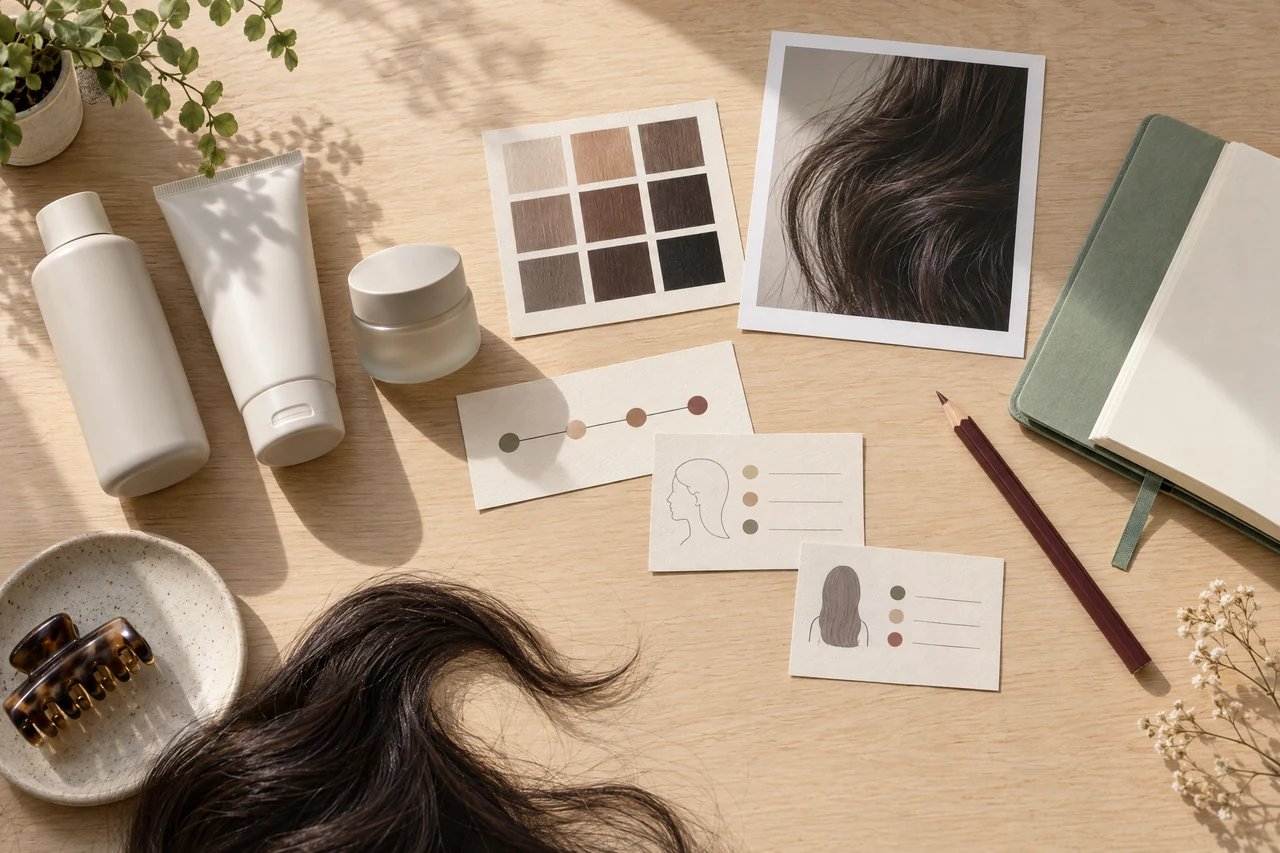
Use the comparison below to decide what each piece of information actually establishes. A photograph can help show the hair's appearance at a particular time, but it cannot identify chemicals. A product name is more informative when linked to your appointment record than when remembered from an advertisement. Keep original wording or screenshots wherever possible, then add your explanation separately so the two are not confused.
Was it a conditioning mask or a different smoothing procedure?
The everyday word ‘treatment’ can describe very different services. A conditioning mask may be intended to improve feel and manageability without being a procedure designed to alter the hair's shape. Another service sold under a similar care-focused name may involve a smoothing formula and a particular application sequence. Remembering softer hair afterwards does not resolve which one you received. Start with the actual product's purpose and instructions, rather than the appeal of its name.
If you remember a jar or a take-home tube, ask whether it was the main salon product or merely the finishing conditioner. The guide to keratin treatment vs deep conditioning explains why an ingredient name does not turn every mask into the same service. An aftercare product purchased that day can be useful context, but it is not automatically the formula that was applied during the appointment.
Safety questions also require the actual product. The FDA's hair-smoothing consumer guidance advises asking salon professionals about ingredients, including formaldehyde-related ingredients. It identifies formaldehyde, formalin and methylene glycol as names to look for. This is general consumer guidance, not evidence that your unknown product contained them. Ask about safe-use instructions and warnings for the proposed product too; a reassuring service title is not a substitute for that information.
Remembered heat and rinse steps are clues, not identification
Record whether you remember washing first, applying a cream or liquid, waiting, rinsing, drying, ironing or applying another product. Do not infer an exact method from any single step: ordinary styling can also include an iron, and your recollection may miss parts of the service. For terminology, the comparison of keratin smoothing vs japanese straightening helps frame questions about the process, without identifying your earlier appointment from its label.
Locate the history on the hair that remains today
An appointment date is only part of the history. Explain whether the earlier product covered the whole head, selected areas or mainly the lengths. Note what has been cut since then and whether later services overlapped those areas. If you do not know how far the product was applied, say so. A patch of new growth does not by itself establish that every section now being considered for straightening has no previous treatment.
Take current photographs of the front, back and sides in clear light, and identify your usual styling in the message. Hair dried with a brush may look different from hair left to dry without shaping; that difference should not be mistaken for proof of what an old product did. Describe where you notice roughness, tangling or shorter broken hairs, but do not use those observations to diagnose chemical compatibility yourself.
Keep a separate note for each uncertain area
In a hypothetical example, someone remembers full-length smoothing before a later fringe cut and highlights through the sides. The fringe, highlighted sides and remaining back lengths would need separate descriptions, even though they belong to one haircut. Mark uncertain boundaries rather than drawing a falsely precise line. That allows the discussion to consider the proposed treatment area instead of relying on a single label for the whole head.

Know what assessment can answer and when to postpone
An in-person discussion can consider the current hair and the proposed procedure more closely than a message alone. Ask whether a strand assessment is appropriate and available, what it would examine and what would cause the service to be declined. An assessment of a sample does not recreate a missing product record or guarantee an identical response across all lengths. It should inform the decision, not be presented as a way to erase every uncertainty.
Postponement makes sense when the earlier process cannot be identified sufficiently, its treated area remains unclear or the proposed product's restrictions cannot be checked. Visible breakage or a scalp that feels irritated adds a separate reason to pause rather than press ahead. Ask what information or change in the plan would allow the question to be reconsidered. ‘Not now’ can be a clear decision even when there is no useful date to promise.
While the enquiry is unresolved, avoid treating repeated hot-tool styling as a harmless substitute. The American Academy of Dermatology's hair-care advice recommends lower heat, less frequent tool use, conditioner and gentle handling to limit further damage. It also recommends seeing a dermatologist when care changes do not help, especially with thinning or hair loss. A past bad reaction to smoothing should be disclosed and discussed with a healthcare provider, not interpreted through a salon photograph.
There is no automatic countdown for an unidentified product
A generic waiting period cannot identify what was applied or establish that a new procedure is suitable. Even if the visible smoothing effect has faded, that does not resolve the history of the lengths you want treated. If chemical work is deferred, discuss a cut, a more manageable temporary finish or keeping some natural bend. Choose an interim plan that meets your priorities without promising that care products make another process safe.
Send an enquiry that leaves the decision open
Use these 6 preparation items to make your first message useful. You can send the record you have rather than delaying contact indefinitely while searching for a missing receipt. Keep the central uncertainty at the beginning, then attach the supporting material. If you are enquiring about hair straightening, explain that the earlier smoothing product is unidentified and ask what details are needed before discussing a proposed procedure or appointment.
A practical message might read: ‘I would like a straighter outline but cannot identify my previous smoothing product. The service was around this date and I think it covered these areas. Here are the records I found and the steps I remember. These lengths were coloured afterwards. Could you advise what further information or assessment is needed? I understand that a chemical service may need to be postponed.’ Adapt it to your facts rather than copying details that do not apply.
Ask for a record if a future service goes ahead
If a service is later agreed, request the actual product name, treated areas and procedure-specific aftercare instructions for your own notes. Raise any future colour or perm plans before proceeding. A written record makes later enquiries more useful, but does not approve a future treatment in advance. Confirm the proposed service, charge and appointment separately, and ask about consultation language if that matters to you. An English website alone does not confirm an English-speaking consultation.
What your recovered information can establish about the earlier smoothing service
| Information available | Useful evidence | What remains uncertain |
|---|---|---|
| Dated receipt with a broad smoothing label | Appointment timing and recorded menu wording | Exact product, formula and application areas |
| Product and variant linked to the appointment record | A more specific identity to investigate | Whether the complete procedure and all treated areas are documented |
| Memory of drying and repeated ironing | Application steps to mention in the enquiry | Product identity; heat alone does not name the service |
| Take-home mask or conditioner | Aftercare context and the item's own label | Whether the same product was used as the main salon treatment |
| Photographs before and after the visit | Appearance, approximate length and styling context | Formula, compatibility and the condition of every current section |
Your preparation checklist
- Save the approximate appointment date and the original service wording.
- Attach any product identity tied to that appointment, noting missing details.
- Write remembered application steps without guessing products or temperatures.
- Describe treated areas, later colour or perms and subsequent cuts.
- Provide current photographs with your usual drying and styling routine explained.
- State your preferred shape, current concerns and willingness to defer chemical work.
Frequently asked questions
Can I enquire if the old salon cannot recover the product name?
Yes. Send what is known and explicitly say that the product identity could not be recovered. An enquiry can establish what further information or assessment is needed. It does not mean a chemical service can be agreed; a different styling plan or postponement may be the appropriate response.
Does ‘keratin’ on my receipt prove that it was only a mask?
No. That word does not identify the complete formula or procedure. Ask whether the receipt refers to a conditioning product, a main smoothing service or an aftercare item. Remembered steps can guide the questions, but should not be upgraded into a confirmed product identity without supporting records.
How long should I wait before trying straightening again?
There is no reliable waiting period to recommend from an unidentified service alone. The remaining treated lengths, later processing, current condition and proposed product all matter. Ask what needs to be clarified before reconsideration rather than assuming that a faded result or a calendar date supplies clearance.
Ask about straightening with an honest treatment history
Enquire with Vit So on WhatsApp at +85253057561 and send the earlier service wording, available records and current hair photographs. Explain that the smoothing product is unknown and describe the shape you would like. The address is 252 Hollywood Road, Sheung Wan, Hong Kong. Ask what further details are needed; the proposed service, suitability, charge and appointment require confirmation.
Start your WhatsApp enquirySources & further reading
- Hair Smoothing Products That Release Formaldehyde When Heated — FDA
Consumer guidance on asking about smoothing ingredients, product warnings and past reactions. It supports product-specific questions, not a diagnosis of an unknown earlier formula or confirmation of Vit So's products.
- 10 hair care habits that can damage your hair — American Academy of Dermatology
Practical advice on gentle handling, conditioner, limiting heat and seeking dermatology assessment for persistent concerns or hair loss. Its general timing advice is not a clearance rule for an unidentified smoothing service.



