







Brand relationship disclosure: OWNSTRAND and Vit So have the same owner. This article offers cosmetic selection guidance, not an independent review or product test. Confirm styles, availability and visit arrangements with OWNSTRAND directly.
Map a hair topper footprint for an off-centre part in four directions
Start with dry hair arranged in your normal off-centre part, without pulling the sides apart to exaggerate exposure. Note where the visible concern begins and ends, including any continuation towards the crown. OWNSTRAND's hair topper for widening part guide similarly asks readers to consider the whole visible zone and the surrounding hair. Its advice provides product-enquiry context, not an assessment of why one side appears more sparse or proof of an individual result.
Use four directional records: the front endpoint, the back endpoint, the reach to your left and the reach to your right. Label left and right from your own perspective, because mirror views and phone photographs can reverse them. At the front, middle and rear of the concern, describe how far the desired coverage extends from the part on each side. This preserves a taper or bulge that one widest-width measurement would hide.
Make the record repeatable with a top view and side views taken at similar distance and in soft daylight. Avoid filters, wet hair or unusual styling products if they do not represent your normal appearance. A photograph can help communicate a boundary but is not a reliable ruler on a curved head. Record any physical measurements with units and method; if they are difficult to obtain without tugging, leave them for a fitting discussion.
An asymmetric thinning coverage map describes appearance, not cause
On a sketch or a copy of your photograph, mark the visible area you want softened and keep the daily part identifiable. Call this your asymmetric thinning coverage map. Unequal exposure can change with hair direction and lighting, so the label describes your cosmetic concern rather than a medical condition. Do not use the map to decide whether remaining hair is healthy enough for clips; that is a separate question.
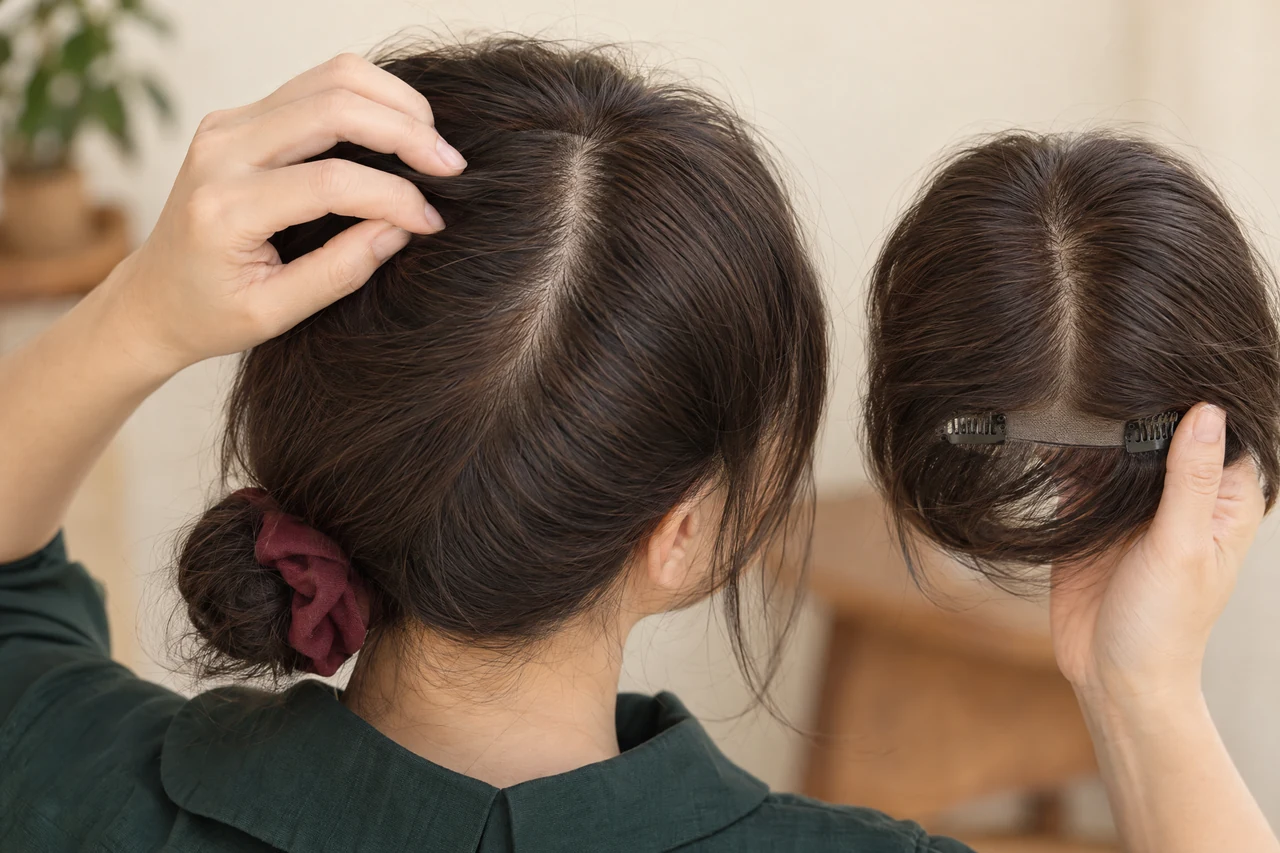
Separate the visible zone from the base and supporting hair
The visible zone is what you want covered; the base footprint is where the foundation would sit; attachment support is the hair or contact area the fixing method needs. These are not interchangeable outlines. OWNSTRAND's hair topper base size guide explains that shape, edges and attachment points affect positioning beyond the headline dimensions. Compare your map with those details rather than assuming that a base just larger than the exposed area automatically provides suitable support.
Create a second sketch showing surrounding hair that could participate in blending and the proposed attachment locations for a particular model. Mark uncertain areas as uncertain, not as safe. The hair on the wider-looking side may be less useful for concealing an edge or holding a fixing than the hair on the other side. A fitter needs to discuss those locations individually; neither a photograph nor a home measurement establishes how much pulling a strand can tolerate.
Keep strand texture separate from how much hair is present. Soft, fine strands do not necessarily mean low density, and a visually fuller area does not prove it will tolerate repeated fixing. The distinction in fine hair vs thin hair helps you describe texture without treating it as a diagnosis. Tell the fitter about slipping, breakage or discomfort with existing accessories, rather than deliberately testing the hair's strength by pulling it.
Do not add a universal attachment margin
There is no numerical margin established by the sources here that makes every topper edge or clip position appropriate. A base extending beyond the visible zone may place a fixing in a different area, but the actual outline, fixing location and wearing comfort still need checking. Ask how the specific model is intended to sit. Do not convert a general sizing chart or another wearer's measurements into a support rule.
Compare the base outline without moving your daily part
An off-centre part is a hairstyle reference, not necessarily the centreline of the topper's foundation. A symmetrical oval could extend farther to one side of that part if its construction permits the intended placement. Conversely, a generous overall width may still fall short at a tapered rear corner. Keep the usual part fixed while comparing outlines, and ask where the model's visible part can sit relative to its base. Do not assume every piece allows an adjustable part.
For each candidate, request an outline or underside view that identifies the front and shows fixing positions. Establish whether the stated length runs front to back and whether the width is the widest point. If you use a paper outline to understand the shape, keep it as a desk-based comparison: it does not reproduce head curvature, flexibility or comfort. A size label alone leaves too much unknown to decide where both side edges would land.
Imagine a concern that reaches much farther right at the middle but narrows at the back. A base centred on the part may leave the middle-right edge exposed, while a sideways shift may change the left fixing position and front alignment. Record the conflict instead of assuming rotation will solve it. Rotating a model can also change hair direction and fixing locations; whether that placement is allowed depends on its original instructions and a fitting discussion.

Reject pulling and edge exposure before adding more coverage
During a fitting, inspect both side edges separately with the part in its everyday position. Look at the narrower side for a bulky step or an edge that is difficult to blend, then check the wider side for exposed areas the base has missed. Turn slightly and lower your head gently according to the fitter's guidance. The purpose is to observe changing visibility and comfort, not to stress-test the fixing or prove security through vigorous movement.
Do not accept pain as the price of keeping a base in position. The American Academy of Dermatology says repeated pulling can lead to hair loss and identifies pain, scalp stinging and crusts as warning signs requiring a change away from the pulling style.[2] This is general tension advice, not a study of a particular topper. If a fitting pulls or irritates, stop and ask for reassessment rather than tightening it to conceal an edge.
A larger footprint is worth considering only if its actual outline resolves the missed area without creating another problem. It may move a fixing to a different location, but may also extend into hair you wanted left visible or create extra styling work. Ask which issue a proposed change solves: insufficient coverage, an awkward edge, uncertain support or unsuitable construction. New scalp symptoms, ongoing discomfort or treatment-related wearing needs belong with an appropriate care professional.
Shortlist exact partial pieces, not category promises
Use OWNSTRAND's hair toppers page to begin an item-specific shortlist once your two maps are ready. The page asks readers to compare footprint and attachment, then construction, fibre, length and colour; it explicitly treats catalogue references as distinct from stock confirmation. OWNSTRAND and Vit So have the same owner, so this referral is to a sister brand, not an independent review. Neither Vit So nor this commissioned article is claiming to have tested the shortlisted products.
Keep a compact record for each candidate: confirmed base outline, allowed part location, fixing positions and the unanswered questions. Then compare the hair falling around each edge with your own length, texture and colour. Natural light is useful for colour comparison, as the American Cancer Society recommends in its general wig guide.[1] A catalogue shade image cannot establish the match on your head, and a construction label does not establish the exact parting range.
If the map needs coverage beyond a workable partial footprint, revisit the format rather than treating a topper as compulsory. The American Cancer Society distinguishes a top piece that adds coverage on top from a full wig covering the entire head.[1] The hair topper vs wig comparison can help frame that broader decision. Its full-wig alternatives do not diagnose your hair change, and the society's full-wig sizing chart is not a topper footprint chart.

Bring a two-map enquiry and keep the unanswered details visible
Prepare the visible-coverage map and the separate support notes together, with photographs showing your fixed part. Explain which side needs more apparent coverage, where that difference is widest and how much of your natural hair you want to keep visible. Include your usual styling routine and any restrictions on heat or accessories. This gives a fitting conversation a clear starting point without pretending you have already selected the right construction or established suitability at home.
A discussion about hairpiece fitting can address appearance and blending, including the transition at the two unequal edges. Before altering a piece or your own hair, clarify which adjustments are possible for the exact item and who would provide them. Ask about any implications for return or exchange terms. Do not assume cutting, repositioning clips or heat styling is permitted simply because a piece has human hair or a familiar base name.
Send product and visit enquiries to OWNSTRAND through the guides already linked, and confirm measurements, fibre, fixing instructions, quotation and current availability for the exact option. OWNSTRAND has one store in Kwun Tong; it is not Vit So's Sheung Wan location. Confirm any sample-viewing or fitting arrangements before travelling. Your useful outcome is a clearly explained candidate or a reason to pause, not an automatic order based on a width figure or a photograph.
How an unequal coverage map changes the footprint enquiry
| What your map shows | What to compare | What not to assume |
|---|---|---|
| The wider zone is mainly beside the middle of the part | Both side reaches and the base outline at that position | The part must be centred in the base |
| The zone widens towards the crown | Rear outline, rear fixing positions and hair direction | Maximum width also describes the rear corners |
| The narrower side has little hair for concealing an edge | Edge visibility and the specific fixing location | Moving the piece sideways resolves every conflict |
| The base covers the zone but creates pulling | Comfort and attachment suitability before styling | Tighter fastening is an acceptable solution |
Your preparation checklist
- Keep the daily off-centre part unchanged in all reference views.
- Label the front and back endpoints and both side reaches, using your own left and right.
- Record units, measurement paths and any uncertain boundaries.
- Separate visible coverage from surrounding hair and proposed fixing locations.
- Obtain the exact model's outline, orientation, permitted parting and attachment instructions.
- Check both edges and stop if the fitting pulls, stings or irritates.
- Confirm the item, quoted price, supply and visit arrangements before committing.
Frequently asked questions
Does unequal coverage mean I need an asymmetrical base?
Not necessarily. A symmetrical base may cover unequal distances from the daily part if its design permits the intended placement and part position. The deciding issues are the actual perimeter, fixing locations and blend on each side, not whether the shape has an asymmetrical label.
Should I buy a wider base and shift it towards the sparse side?
Treat that as a placement question, not a home fitting rule. A shift can change the opposite edge, front alignment and attachment locations. Keep your part fixed and ask how the exact model would sit; do not use extra width to conceal a support or comfort problem.
Can a top-view photo provide my final measurements?
It is useful for showing the shape and unequal sides, but perspective and head curvature can distort distances. Supply the photo with any measured units and method. If you cannot measure comfortably, ask for fitting help rather than presenting a photograph-derived number as a final base size.
What if I must sweep lots of natural hair across one edge?
Show the fitter that styling requirement with your usual part intact. It may indicate an awkward perimeter or a mismatch with the amount of hair you want left visible. Discuss another outline, construction or coverage format instead of assuming a larger base or tighter fixing will make the transition work.
Discuss the two edges before choosing a footprint
Bring your fixed-part photographs and coverage notes to a Vit So discussion about style blending. For OWNSTRAND product details or a visit, use the guides already linked and confirm the exact item and arrangements directly.
Start your WhatsApp enquirySources & further reading
- Wigs for Hair Loss — American Cancer Society
General distinction between top-piece and full-wig coverage, and natural-light colour comparison; its full-wig sizing chart is not applied to topper footprint measurement.
- Hairstyles that pull can lead to hair loss — American Academy of Dermatology
General guidance that repeated pulling can cause hair loss and that pain, stinging or scalp crusts warrant stopping the pulling style; not a topper-specific attachment study.



