







Brand relationship: OWNSTRAND and Vit So are sister brands under the same owner. This article offers selection guidance, not an independent review or product test. Confirm styles, supply and visit arrangements directly with OWNSTRAND.
Hair topper length for a blunt bob starts with the outline
If the goal is fuller-looking hair at the top while retaining your bob, partial coverage may be worth comparing. OWNSTRAND's guide to hair toppers explains checking the footprint and attachment alongside fibre and length. The American Cancer Society likewise distinguishes top pieces that add top-of-head coverage and volume from full wigs that cover the entire head.[1] Neither description establishes that a particular piece will blend with your bob. Your exposed natural hair still contributes to the finished outline.
Treat the perimeter as the visible boundary around the bottom of the haircut, not simply its longest strand. A blunt bob haircut relies on a deliberately definite end line; light surface movement does not necessarily mean that boundary should be softened. Photograph your hair dry, with your usual part, from the front, both sides and back. Note whether the front is longer, whether the nape curves inward, and which corners you especially want to retain.
Write the brief plainly: add fullness at the crown, keep the existing jaw-length outline, and do not thin the natural ends. That separates a coverage goal from a haircut change. Adding hair may also change the width or roundness above the line, even when the bottom remains unchanged. Decide whether that extra volume is desirable. If a proposed piece makes the silhouette too rounded, reconsider its density or shape rather than immediately removing weight from the bob underneath.
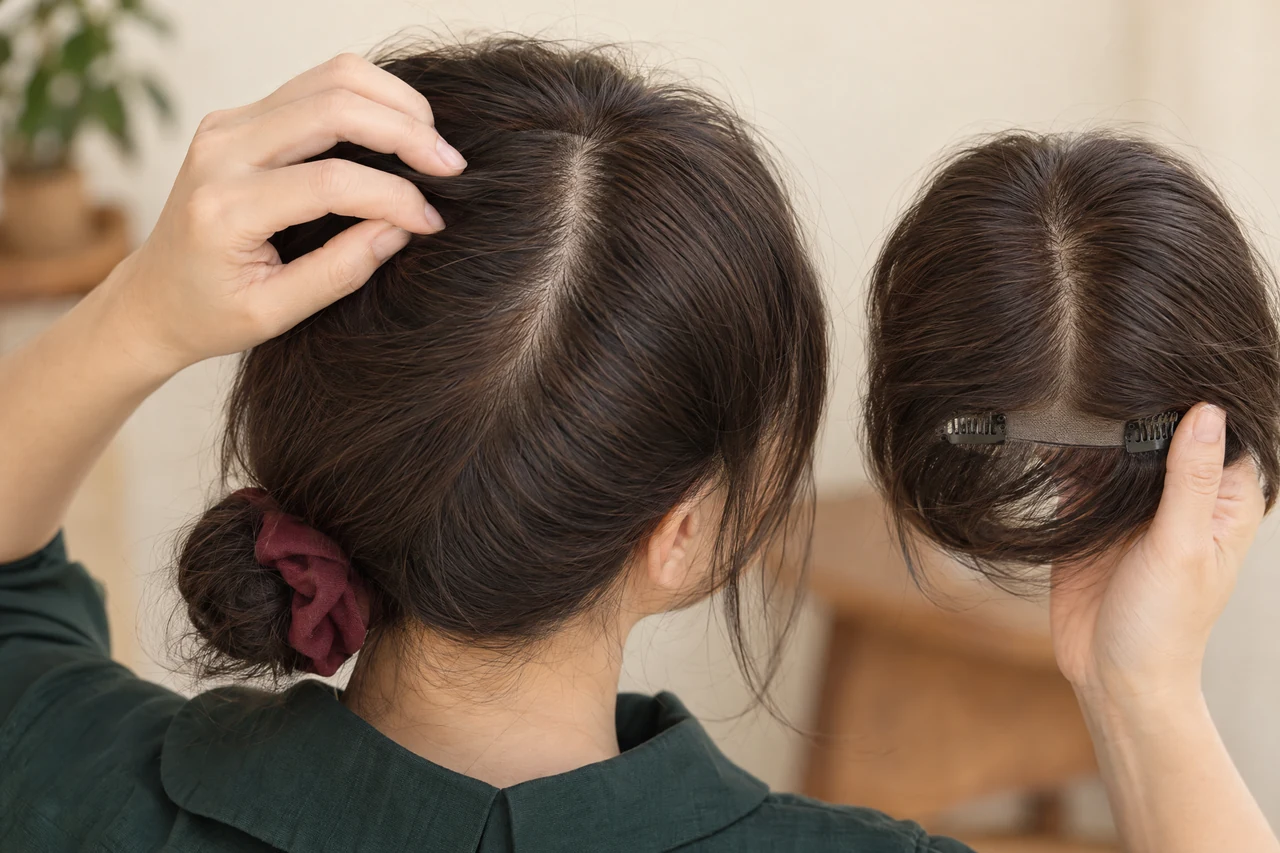
Compare the worn drop, not two unrelated length labels
A topper's stated hair length and your bob's visible length may start from different points. A listing can distinguish front, side or crown measurements, while a casual description such as chin length describes where the haircut ends on the wearer. Ask what the manufacturer's number measures and whether the piece is already layered. Base dimensions describe the area resting on the head; they are not the length of hair hanging from it. Do not substitute one measurement for the other.
Compare the candidate from its intended wearing position, with the hair settled in the direction you actually use. The relevant question is whether the strands intended to join the outline reach the required line at the sides and back. They need not all be identical lengths, but a longest strand reaching the nape says little about a short front section. If trying the exact piece is unavailable, request its measurement map and treat the blend as unresolved rather than relying on a product photograph.
Some extra length can give a stylist room to trim a suitable piece, but buying the longest available option is not automatically safer. A long topper may carry layers or a distribution of fullness that remains unsuitable after shortening. Conversely, a piece that stops well above the desired boundary cannot be made longer by cutting. The shortlist should therefore include the shortest relevant sections as well as the longest length, with any acceptable trim discussed before purchase.
Use four checks before committing
This guide uses four original decision checks: worn reach, shortest layers, habitual parting and permitted alteration. Worn reach asks where the ends settle; shortest layers ask whether an unwanted upper line remains; habitual parting asks whether that shape survives normal styling; permitted alteration asks what can change without sacrificing your bob. Record each as confirmed, unresolved or unsuitable. This is a practical comparison method, not a clinical scoring system or evidence that a product has passed testing.
Assess topper layers over a blunt perimeter before cutting
When considering a human hair topper, ask about its existing front, crown and side layers as well as any permitted alteration. OWNSTRAND's guide separates the human-hair label from item-specific construction and care permissions. That distinction matters for a bob: human hair does not mean a short layer can be lengthened, that every part can be moved, or that colouring and heat are automatically allowed. Ask whether the exact piece can be shaped while leaving your natural end line intact.
Look for an unintended second outline above the bob. A short surface layer might fall around the cheek or ear, making the upper hair look separate from the heavier ends below. Some readers welcome that texture; others want a quieter, more continuous surface. Topper layers over a blunt perimeter are not inherently wrong, but the position and amount of layering must match the intended look. Trimming lower ends alone will not remove a short upper layer unless the overall design changes.
Distinguish the amount of hair at the ends from its texture. A piece can reach the right level yet appear too wispy beside a solid natural boundary, or too full through the sides. A slight bend may also make equal strand lengths appear to finish at different heights. The American Cancer Society advises against using a hair dryer or curling iron on a wig unless it is heat resistant.[1] Confirm the exact topper's instructions before treating heat as the solution to an outline mismatch.

Test the usual part and watch the ends in motion
A parting changes how hair is distributed over each side, so inspect the shape with the part you actually wear. Establish the item's intended position and permitted parting first; do not assume every base allows a free choice. A side part can make one side look fuller and place different layers near the cheek. Compare that fall with the natural hair below. A convincing centre-part photograph is not enough if you normally use a deep side part and tuck one side behind an ear.
Where an appropriate try-on can be arranged, look at the dry silhouette rather than only a freshly arranged front view. Gently turn your head, look down and return upright. Check whether a short section separates from the bob or whether longer strands hang below its boundary. Include the back using a second mirror or a photograph. The purpose is to see your routine shape, not to demand that every strand remain perfectly still or conceal every edge in every position.
Try your everyday part before an alternate look
Begin with hair loose, then reproduce an ordinary ear tuck if the piece and attachment permit it. Notice which ends move behind the ear and whether the front corner remains recognisable. If you sometimes change sides, ask whether that alternate part is supported and check it separately. When a blend works only with careful combing in one direction, decide whether maintaining that direction suits your morning routine. Record the limitation rather than assuming another cut will necessarily solve it.
Agree on piece-only alterations and a comfortable fit
Separate alterations to the topper from alterations to your natural hair. For hairpiece fitting, explain that preserving the natural perimeter is a condition of the discussion, not an optional finishing detail. Ask the stylist to identify which strands would be shortened or softened and what would remain when the piece is removed. The American Cancer Society mentions professional trimming when a wig needs styling.[1] That general advice is not a reason to thin your own bob or permission to alter every hairpiece.
A staged discussion is preferable to an irreversible first cut. Confirm the wearing position, identify excess length, and agree on an initial conservative change before assessing again, if alteration is suitable for that item. Do not attempt to reshape the base or relocate attachments yourself. Ask the supplier how cutting affects return or exchange terms before authorising work. If the proposed blend depends on removing the natural bob's weight, pause: you are being offered a different haircut, not merely added top coverage.
Do not move or tighten a piece simply to make its ends reach the line. The American Academy of Dermatology warns that repeated pulling can cause hair loss and that a painful hairstyle is too tight.[2] This is a general tension precaution, not a finding about a specific topper. If attachment causes pain or stinging, stop the trial and seek appropriate fitting advice; persistent scalp symptoms or new hair loss warrant a healthcare professional. Treatment-related wearing needs should be discussed with your care team.

Request a quote that separates the piece from blending work
Use the hair topper prices guide to separate the cost of the exact piece from any fitting, trimming or adjustment you are requesting. OWNSTRAND says such work may be included, separately quoted or unavailable for an item. Send the model reference, desired colour and bob photographs, then ask what the quote actually covers. A category page or catalogue record does not confirm current supply, and an enquiry does not reserve a piece or complete an order.
Keep the product and styling conversations distinct. OWNSTRAND and Vit So are sister brands under the same owner, not independent reviewers of one another. OWNSTRAND has one store in Kwun Tong; Vit So's salon is in Sheung Wan. Confirm viewing, try-on and item-specific alteration arrangements with the relevant business rather than assuming a visit to one covers both. This article is commissioned selection guidance, not evidence that Vit So reviewed, fitted or product-tested any of the listed toppers.
If no candidate meets the four checks without unwanted changes, it is reasonable to wait or compare another coverage format. The hair topper vs wig guide helps distinguish partial from fuller coverage, but a full wig is a different decision rather than an automatic fix for a difficult bob blend. You can also keep the bob unchanged while seeking clearer product measurements. A precise unanswered question is more useful than buying on the assumption that cutting will solve every mismatch.
Four observations that help protect a blunt bob's end line
| What you observe | What remains to check | Decision before cutting |
|---|---|---|
| Ends reach below the bob | Shortest layers and distribution of fullness | Discuss a piece-only trim; extra length is not enough by itself |
| Longest hair reaches, but side layers stop high | Whether that upper outline suits the intended look | Do not expect shortening lower ends to lengthen upper layers |
| Reach is right but the sides look rounded | Density, base position and normal hair direction | Compare another shape before thinning natural ends |
| The line works only with a different part | Whether the item supports your everyday part | Accept a styling restriction only if it suits your routine |
Your preparation checklist
- Photograph the dry bob's front corners, both sides and back in your usual part.
- State explicitly whether the natural perimeter must remain unthinned and unchanged.
- Request the exact model's length map, including its shortest front and side layers.
- Confirm the intended base position, attachment, parting options and fibre-care limits.
- Discuss permitted piece-only alterations and return terms before any cutting.
- Request a current item quote, supply check and separate confirmation of fitting or blending work.
Frequently asked questions
What inch length should I buy for a chin-length blunt bob?
There is no universal number. Chin length describes an endpoint on your face, while the topper's measurement may start at a specified point on its base. Compare the worn reach at the front, sides and back, then check shorter layers. Ask for the manufacturer's measurement method before treating two length labels as equivalent.
Is a longer topper always safer because it can be cut?
No. Additional length may allow trimming, but cannot lengthen pre-existing short layers or automatically correct density and shape. Before choosing a longer piece, confirm that its layer pattern suits the bob and that alteration is permitted. Agree on who will cut it and how that affects return terms.
Can short top layers coexist with a blunt bottom line?
They can be part of the intended look, provided the upper fall does not create an unwanted separate outline. Assess where the short sections finish beside your cheek and ear in your normal part. If you want a smooth surface, seek a compatible layer pattern rather than sacrificing the natural perimeter to disguise a mismatch.
Should I thin my own bob so the topper looks less separate?
Not as a default when preserving the bob is your priority. First clarify whether the mismatch concerns reach, layers, fullness or parting. Ask what can be changed on the piece alone. If the only proposed solution is thinning the natural ends, decide consciously whether you want that haircut change or would prefer another candidate.
Bring a bob-preservation brief to the styling discussion
Ask Vit So about the silhouette you want to retain and whether blending work can respect that boundary. For the exact topper's measurements, supply and visit arrangements, use the OWNSTRAND guides already linked above. Include your usual part, dry photographs and a clear request not to thin the natural perimeter; confirm what each business can provide before booking.
Start your WhatsApp enquirySources & further reading
- Wigs for Hair Loss — American Cancer Society
General distinction between toppers and full wigs, caution against heat styling without heat resistance, and professional trimming when needed. Not a brand endorsement, bob-length formula or confirmation of a particular topper's specifications.
- Hairstyles that pull can lead to hair loss — American Academy of Dermatology
General guidance that repeated pulling can cause hair loss and painful tight styling should be changed. Not a clinical evaluation of topper clips or individual medical suitability.



