







Brand relationship: OWNSTRAND and Vit So have the same owner. This article offers selection guidance, not an independent recommendation or product test. Confirm styles, supply and visit arrangements with OWNSTRAND.
Wig fit for uneven head measurements starts with proportions
Uneven measurements can mean that your circumference matches one size while your front-to-back length or ear-to-ear span matches another. It can also mean that one side of a cap feels different from the other. Those are observations, not diagnoses. A single circumference cannot explain where the crown sits or whether the nape reaches its intended position. Write down the specific mismatch before deciding that all standard caps are unsuitable.
The American Cancer Society's measuring guide separates circumference, front-to-back and side-to-side measurements, and warns that size charts vary between brands.[1] Use those three readings as the starting point for comparison, then add a fourth check: contact during ordinary movement. This four-check method is an organising tool for a purchase discussion, not a medical test. A chart can narrow a shortlist; it cannot tell you how an edge feels against your own head.
Confirm coverage before committing to a full cap. If your goal is limited to the crown or parting, a partial piece might be a different comparison, although its attachment and blending still need checking. Vit So's guide to full head wigs explains that scope. Do not assume a topper automatically solves an asymmetric fit problem: it changes the covered area and fastening questions rather than guaranteeing that contact will be comfortable.
Record repeatable measurements before changing size
Ask the fitter which landmarks and tape routes the relevant manufacturer uses. Record circumference around the head, front-to-back over the crown and ear-to-ear across the top using that method, with units clearly marked. Keep the tape in gentle contact rather than pulling it tight, and repeat a reading if it changes when you reposition it. If your numbers straddle chart sizes, send all of them; do not silently substitute a guessed average.
Keep the conditions consistent. Note how you arranged your natural hair and whether you intend to wear a liner or grip with the wig. A bulky bundle on one side can complicate a fit comparison. Cancer Research UK notes that a wig tried over existing hair may need a smaller size after hair loss, and recommends asking a fitter about adjustment.[2] If hair volume will change, say so rather than treating today's measurements as permanently fixed.
Before attributing a mismatch to head shape, check that the cap is facing the right way and that its edge has not folded under. Cancer Research UK specifically advises checking front/back orientation and following the supplier's wearing and care instructions.[2] The wig care guide provides handling context, but the selected piece's instructions take priority. Measure and compare an undistorted cap; do not stretch, cut or wash an unpurchased sample to make it conform.
Different routes are not interchangeable
An ear-to-ear measurement over the top is not the same as a straight width across the face or a tape taken around the forehead. Describe the route alongside the number, especially if another person helped. For a left/right concern, describe which edge lifts or presses and ask the fitter whether additional measurements are useful. Do not invent a separate asymmetry score from unmatched tape routes.
Shortlist cap shapes, not just petite or average labels
A useful shortlist separates the style you like from the cap information still missing. OWNSTRAND's wigs Hong Kong page offers catalogue browsing by cap construction and size alongside fibre and appearance. Save the exact style name and ask for its size chart, adjustment details and fitting arrangements. A displayed style or category is not proof that it is held locally, available to try on or proportioned to suit your measurements.
Imagine a wearer whose circumference falls near an average label but whose front-to-back reading needs more depth. Tightening a shallow cap does not establish that it has enough length to reach the nape while the front stays in place. Conversely, a cap that is roomy at the crown may remain loose there after its lower edge is tightened. These are reasons to compare another cap pattern, not evidence that one named construction will always outperform another.
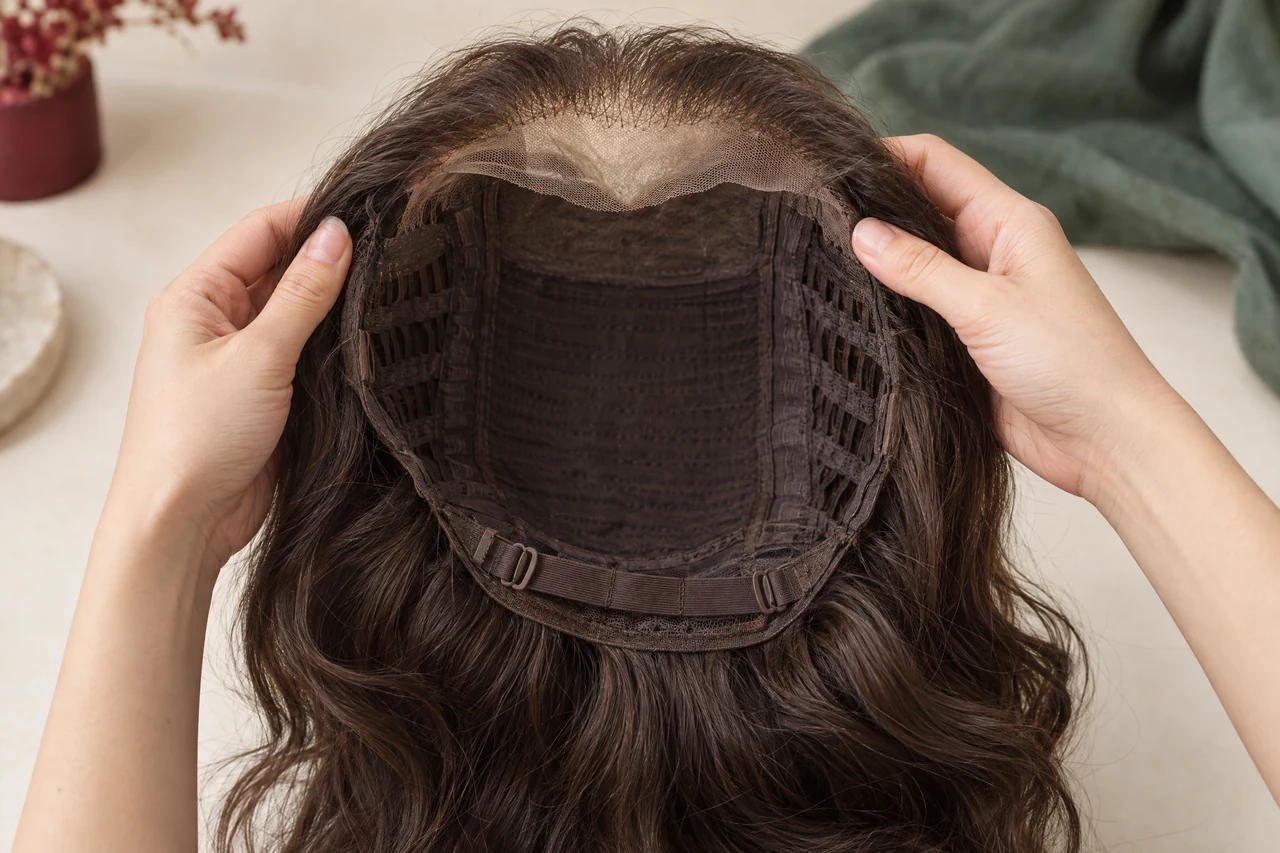
Look inside the actual sample if one is available. Ask where the adjustable elements act and whether the crown, sides and nape have different stretch or reinforcement. Terms such as lace front or hand-tied do not supply a complete dimensional drawing. A fibre choice also does not settle cap shape: human hair and synthetic designs both require item-specific fit checks. Avoid choosing a more expensive material to solve a proportion problem that has not been identified.

Test adjustment without trading one pressure point for another
Follow the sample's instructions and ask the fitter to establish the intended front position before touching the adjusters. Check the sides and nape without dragging the front down to hide a gap elsewhere. The American Cancer Society advises that ear tabs sit evenly slightly in front of the ears and that the wig should not be placed over them.[1] If your anatomy or the cap design makes that placement difficult, request an individual assessment rather than forcing visual symmetry.
Change one adjustment at a time so you can tell what it does. After a modest change within the permitted range, notice whether the front stays settled, the ear areas remain comfortable and the nape lies without pulling. A cap that stays in place only while you hold an edge has not passed the same check as one that sits by itself. If securing the nape creates temple pressure, record that trade-off rather than tightening further.
Once seated comfortably, speak, turn your head gently and lower your chin as you would while reading. Put your everyday glasses back on and check each ear separately. These movements are practical observations, not a durability or all-day comfort test. Ask about a longer wearing assessment where available, and stop if you feel pain, persistent pulling or irritation. Symptoms, recent surgery or treatment-related wearing restrictions belong with an appropriate healthcare professional, not a cosmetic fitting guide.
Use a contact map instead of a pass/fail guess
Make separate notes for the front, crown, left ear, right ear and nape. Use plain descriptions such as loose, settled, pressing or lifting, and record the adjustment setting. If reducing looseness at one location creates pressure elsewhere, the map shows what remains unresolved. It also helps you compare two caps without assuming that the one with tighter straps is the better fit.
Bring persistent proportion mismatch to a custom enquiry
A custom discussion becomes useful when the same placement conflict remains after correct orientation, consistent hair preparation and appropriate adjustments, especially across more than one plausible ready-made design. OWNSTRAND's custom human hair wig Hong Kong page describes sample viewing, head measurement and a return fitting with washing, cutting and blow-drying. Ask whether the specific depth, width or left/right contact issue you recorded can actually be addressed by its available options.
Bring measurements and the contact map rather than asking only for a cap that fits better. Explain the priority: perhaps keeping the front in place without nape tension, or keeping an ear clear without crown looseness. Vit So's custom made wigs guide helps organise design priorities. Keep fit changes separate from a fringe trim or density preference; altering visible hair can change the outline without changing an underlying cap dimension.
Before agreeing, ask which measurements inform the build, which cap features can change and how the completed piece will be assessed. Confirm the quotation, individual timing, return-fitting arrangements and what happens if the same mismatch remains. OWNSTRAND has one store in Kwun Tong; its product enquiries should not be confused with Vit So's Sheung Wan location. OWNSTRAND and Vit So have the same owner, so this is a disclosed sister-brand referral, not an independent review.

Asymmetric wig cap fitting questions that lead to a decision
Choose ready-made when the specific cap sits comfortably at the intended landmarks, leaves usable adjustment room and remains settled during the movements you tested. Consider a custom enquiry when achieving one of those conditions repeatedly undermines another. OWNSTRAND's custom vs ready-made wigs guide makes the same important boundary explicit: neither route automatically fits better, and ready-made does not mean immediate local stock. Ask what adjustment can establish for your selected option, not what the label promises.
Useful asymmetric wig cap fitting questions are concrete: Can you assess the left and right contact separately? Which dimensions can this cap accommodate? What adjustment remains after it is fitted? What would be changed if the nape still pulls? If those answers are unavailable, pause rather than allowing a hairstyle photo to substitute for fit evidence. You can retain a preferred colour or silhouette while leaving the purchase decision open until the cap information is clearer.
Check return and exchange terms before committing; the American Cancer Society recommends doing this before buying a wig.[1] Ask whether fitting, trimming, lace alteration or wearing changes those terms, and obtain the seller's actual answer. There is no universal measurement difference that requires custom work. The decision rests on repeatable observations and confirmed service options. A comfortable sample check is useful, but it is not proof of long-term comfort, future supply or a medical outcome.
Ready-made or custom: compare what the actual cap and service can establish
| Decision point | Ready-made adjustable cap | Custom enquiry |
|---|---|---|
| Mixed size-chart readings | Compare all three dimensions with the exact model's chart and a fit check. | Ask which dimensions inform the build and what can be varied. |
| Front fits but nape pulls | Check placement and adjustment; compare another cap pattern if conflict persists. | Describe the conflict and confirm whether added depth or another change is feasible. |
| Left/right contact differs | Assess each side without forcing the cap over an ear or overtightening. | Ask how uneven contact is measured and assessed at the return fitting. |
| Practical commitment | Confirm the selected size, colour, supply, try-on opportunity and return terms. | Confirm design scope, quote, individual timing and unresolved-fit arrangements. |
Your preparation checklist
- Record circumference, front-to-back and ear-to-ear readings with units and the fitter's tape routes.
- Note natural-hair preparation and the liner or grip intended for everyday wear.
- Check front/back orientation and intended hairline position before adjusting tension.
- Describe front, crown, each ear and nape contact separately, including any adjustment trade-off.
- Try gentle speaking and head movements with your everyday glasses; stop for discomfort.
- Confirm exact product specifications, fitting access, supply and purchase terms before choosing a route.
Frequently asked questions
Should I choose the largest size if my measurements fall into different categories?
The American Cancer Society suggests the size closest to the largest measurement when readings do not match its chart, but also says to check the brand's chart.[1] Treat that as a starting point for enquiry, not an instruction to buy blindly. A larger circumference may leave spare material elsewhere; ask how the candidate cap accommodates your longer or wider dimension.
Can tightening one side fix an uneven fit?
It may change how that particular edge sits, but it does not prove that the cap's overall proportions suit you. Follow the item's adjustment instructions and ask the fitter to check the opposite side and front afterwards. If the change shifts a gap or creates pressure, compare another cap rather than assuming stronger tension is the solution.
Does custom mean the maker can reproduce every head-shape difference?
No. The available pattern, materials and service scope determine what can be changed. Describe the specific mismatch and ask what measurements are used, what modification is feasible and how the result will be checked. OWNSTRAND's described measurement and return-fitting process offers discussion stages, not a guarantee that every asymmetric requirement can be met.
What if the fit changes after my natural hair becomes thinner?
Ask for another assessment using your current hair arrangement rather than relying on earlier readings. Cancer Research UK explains that fit can change after hair loss and suggests discussing adjustable sizing with a fitter.[2] If the change is treatment-related or accompanied by scalp symptoms, ask your healthcare team about wearing restrictions before adding accessories or increasing tension.
Prepare a fit brief before choosing a silhouette
Bring your measurements, contact notes and preferred outline to a discussion with Vit So about hairstyle balance and blending. For OWNSTRAND product specifications, samples or a Kwun Tong visit, use the already-linked guides to prepare an enquiry and confirm arrangements before deciding.
Start your WhatsApp enquirySources & further reading
- American Cancer Society — Wigs for Hair Loss
Three measurement categories, brand-specific size charts, ear-tab placement and checking return terms; not brand endorsement or a clinical asymmetry protocol.
- Cancer Research UK — Wigs, hats and scarves
Hair-volume changes, fitter advice on adjustment, correct front/back orientation and supplier instructions; UK funding and generic production timing are not applied here.



