







Brand relationship disclosure: OWNSTRAND and Vit So have the same owner. This article offers selection guidance, not an independent review or product test. Confirm styles, supply and visit arrangements with OWNSTRAND.
Choose wig caps for changing partings by the area you expose
When you move between a centre part and a deep side part each week, ask which portion of the top can actually be exposed. OWNSTRAND, Vit So's same-owner sister brand, explains in its guide to monofilament wigs that mono may mean a defined part, a crown panel or a broader top. Those locations serve different needs. Ask whether both intended part lines fit inside the stated panel, rather than interpreting the word monofilament as permission to part anywhere.
The American Cancer Society describes monofilament mesh at the crown or across the cap and notes its potential for multiple parting directions. That is a general construction explanation, not a measurement of a particular wig. [1] For your comparison, the useful distinction is between a panel that accommodates one familiar line and an area that accommodates two substantially different lines. A crown-only feature does not establish that the front of a deep side part has suitable coverage.
Draw the complete line, not just the front point
Use two photos of your preferred looks, taken from similar angles. Mark the front start and the furthest visible end of each part. If your side part curves towards the crown, include the curve. Ask for a cap diagram showing these routes against the panel boundary. A measurement of overall cap size cannot substitute for the width and front-to-back extent of the usable top.
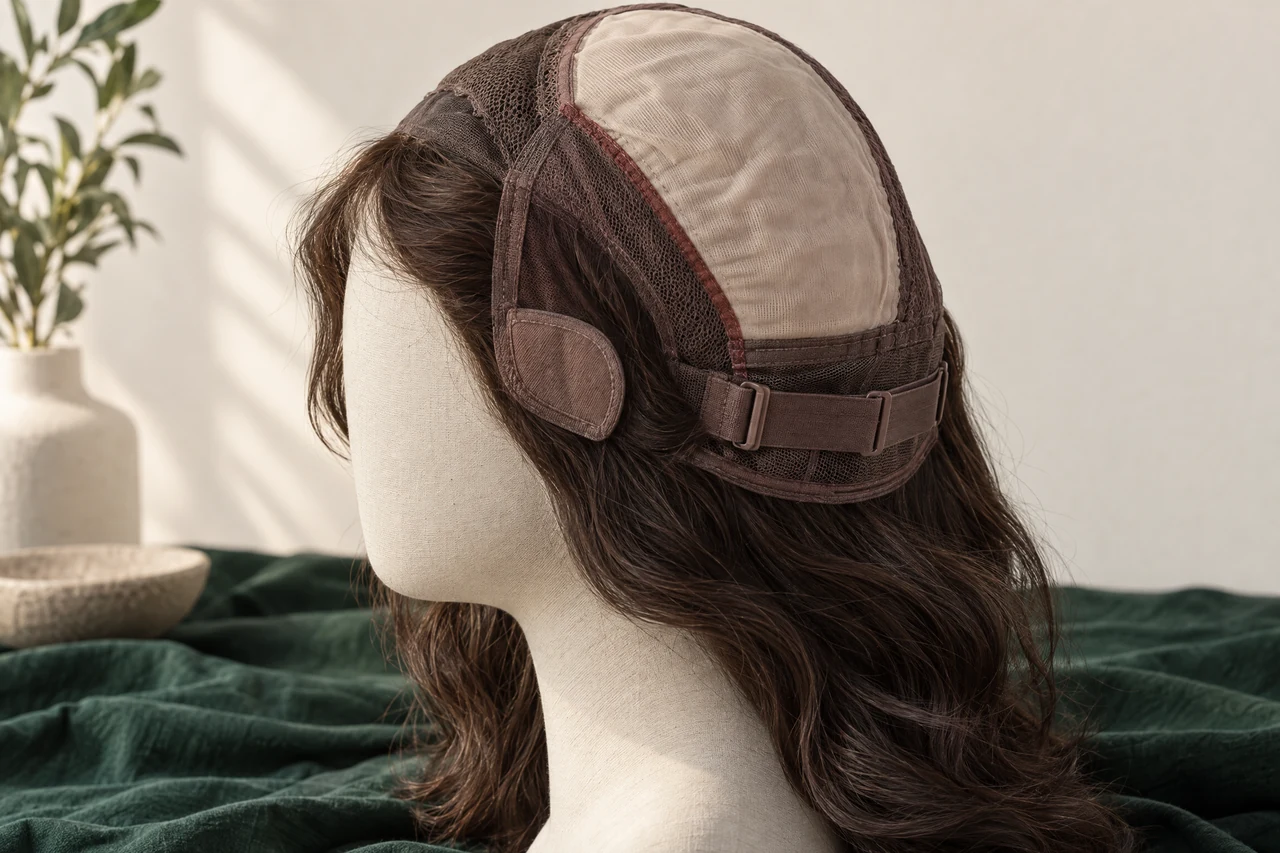
Parting area limits in wig caps are not settled by a top label
A scalp-like finish and freedom to move a part are separate questions. The OWNSTRAND silk top wig guide explicitly asks readers to confirm layers, materials and the extent of the top for the specific model. A close-up showing an attractive centre part does not prove that the same finish continues towards either side. Request the manufacturer's construction description and photographs of both positions, including where the top panel meets the surrounding cap. Do not assume the word silk identifies every material used.
Front-hairline language also needs its own check. The American Cancer Society describes lace front as a sheer panel along the front hairline. [1] That does not measure the entire top. Our explanation of lace front wig vs full lace wig can clarify the vocabulary, but this decision remains model-specific. A convincing front edge can coexist with a narrow parting zone. Likewise, a broader top may still need separate assessment where a side part begins near the temple.
Ask for two views of the same sample
Request an interior view to locate panel boundaries and an exterior view with the hair arranged in each intended position. Keep the sample identity clear; photographs of different wigs do not demonstrate one model's flexibility. If the visible top is photographed only with a fringe or dense hair covering it, ask whether the actual parting surface can be shown before treating its range as confirmed.
Compare whole-cap alternatives without losing sight of fit
Once full-head coverage is your goal, compare complete models rather than isolated top features. OWNSTRAND's women's wigs page lists varied constructions: the displayed Amore Arden entry combines lace front, monofilament and wefted/basic cap descriptions, while Brielle combines lace front, monofilament and hand-tied construction. These are catalogue descriptions, not results from a Vit So fitting or test. Neither entry alone maps your intended deep side part. Request the original manufacturer's information and ask which sample, colour and size can be discussed.
Compare fit before deciding that a wider panel is the better purchase. The American Cancer Society says sizing can vary between brands and recommends checking the brand's size chart. [1] During an arranged fitting, keep the cap correctly positioned rather than rotating it to move the part. Compare your usual glasses and intended liner setup as well. Macmillan notes that a liner can sometimes make a wig move more. [2] Record any shifting separately from whether the part stays inside its panel.
Check the new outline as well as the exposed line
A deep side part changes how much hair falls on each side of the face. Look at fringe length, ear coverage and side volume in both positions before agreeing to a cut. The guide to how to make a wig look natural helps frame that wider comparison. A satisfactory parting surface does not by itself mean that both resulting silhouettes suit the look you want.
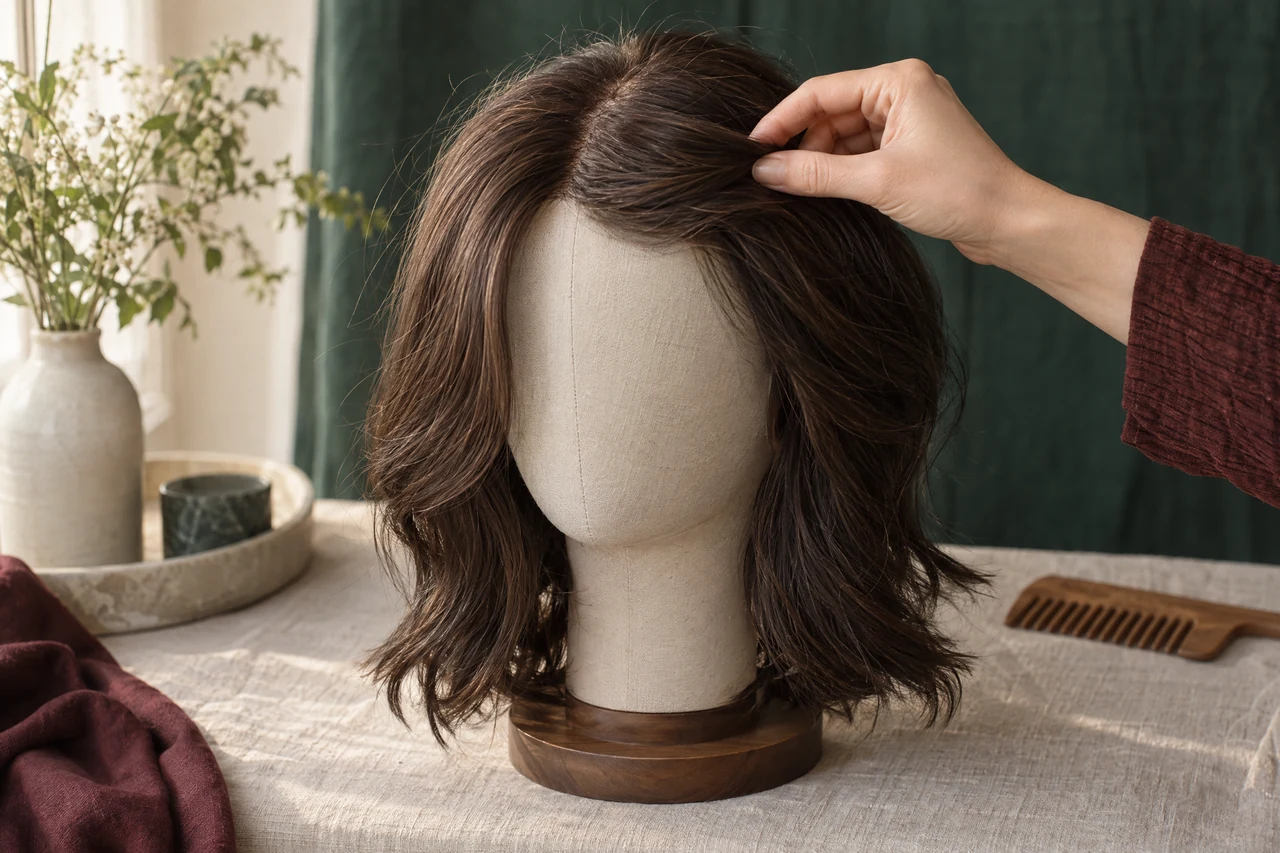
Use four checks to compare a centre part with a deep side part
Use four checks for each shortlisted model: usable area, visible start and end, settled appearance, and repeatable styling. This is an editorial comparison method, not a laboratory rating. First, locate both complete lines inside the confirmed parting area. Second, inspect their front and crown ends for exposed joins or a change of surface. If either route crosses an unconfirmed boundary, keep that model's suitability unresolved rather than allowing a general label to answer for it.
Third, assess the settled appearance with the cap in the same position. Ask the fitter or supplier to arrange the centre part, then the side part using a method permitted for that sample. Look from the front, above and the side without pulling the hair hard to keep the line open. Compare the visible surface and the way the hair falls. These observations help you decide whether the finish is acceptable; they are not promises that the appearance will remain unchanged through wear.
Fourth, ask how you would repeat the switch at home. A style that can be arranged for a photograph may require more work than you want every week. Find out whether the change can be made with gentle finger styling, or needs an authorised washing and styling routine. Include time, tools and any professional assistance in the comparison. Choose the wider construction only when its extra usable area solves your actual styling need and its routine is manageable.
Weekly flexibility also depends on fibre and care
Cap construction describes the base; fibre instructions govern how the hair can be rearranged. Macmillan explains that synthetic wigs can have the style heat-set into the fibre, and that blended wigs may need special care because synthetic hairs can stretch or frizz with heat tools. [2] Do not treat a generous panel as evidence that you can reset every fibre with a dryer or straightener. Ask what the exact wig permits and how the part behaves after the approved care routine.
The American Cancer Society advises against a hairdryer or curling iron unless the wig is heat resistant. [1] Even when heat use is permitted, obtain the maker's instructions for that item rather than borrowing another model's temperature setting. Ask whether any work is needed before you can move between the two looks. Our wig care guide provides a starting point for organising those questions, while the individual manufacturer's directions should determine the method you actually use.
Avoid forcing a stubborn part into place by scraping the base or repeatedly pulling at the attachment points. Ask for a demonstration of the appropriate gentle technique before buying. If the proposed change needs extra product, moisture or professional restyling, make that requirement explicit. A narrower cap that supports your favourite everyday part may be a sensible choice when a weekly change is optional; a wider usable area earns its value when the change is genuinely part of your routine.
Send an enquiry that distinguishes confirmed range from possibility
Send the exact model name with your centre-part and deep-side-part reference photos. Ask for the maker's cap diagram, the usable top dimensions and confirmation of whether both complete routes are intended for that construction. Request a demonstration or clear same-sample photographs where available. If the reply supplies only a hairstyle image or category label, record the parting range as unconfirmed. You can still compare colour and length, but do not base the purchase on flexibility that has not been established.
Then ask about the selected fibre, size, colour, quoted price, supply and any fitting or styling arrangements. Catalogue inclusion is not stock confirmation. OWNSTRAND has one store in Kwun Tong; confirm which sample can be viewed and arrange the visit directly, rather than assuming Vit So's Sheung Wan location is an OWNSTRAND branch. This guide concerns cosmetic selection. If scalp symptoms or treatment-related wearing needs affect the choice, seek advice from your care professional before relying on a routine intended for general styling.
Choose the smallest confirmed range that meets your real plan
If one defined area supports the only part you want, broader coverage need not be the deciding feature. If changing from centre to deep side each week is essential, shortlist a construction only after both lines and the repeatable routine are confirmed. An uncertain specification is a reason to ask another question, not to assume either that the wig cannot work or that it will work.
What each cap description leaves to verify for a weekly centre-to-side change
| Construction description | Relevant comparison | Evidence to request |
|---|---|---|
| Defined parting panel | May suit one consistent line; lateral range is limited to the confirmed zone | Panel width and length; both proposed routes shown |
| Crown-only panel | Crown coverage does not establish front or side-part coverage | Where the panel begins and ends relative to each visible part |
| Broader monofilament top | Potentially more room, not a promise of every direction | Manufacturer diagram and both parts on the same sample |
| Silk-top or layered-top wording | A named surface construction does not measure its parting range | Confirmed materials, boundaries and views at both part positions |
Your preparation checklist
- Save centre-part and deep-side-part photos that show each line's start and end.
- Obtain the exact model's manufacturer construction description and usable top dimensions.
- Confirm both complete part lines sit inside the intended visible parting area.
- Compare the settled looks without rotating the cap or pulling hair hard.
- Ask for a repeatable styling method within that fibre's care limits.
- Confirm colour, size, quotation, sample availability and visit arrangements separately.
Frequently asked questions
Can I move a centre part to a deep side part on a mono-part wig?
Possibly, but the name does not answer it. A defined mono-part area may be too narrow or located away from your proposed side line. Ask for its boundaries and whether the full route, including the front start, can be exposed. If the seller cannot confirm this for the exact model, leave the range unconfirmed.
Does a silk top mean that I can part the wig anywhere?
No. It names a top construction, not a universal parting range. Confirm what the manufacturer means by the term, where that area ends and what surrounds it. A close-up of one finished part can show its appearance in that position, but evidence of both intended positions is needed for your comparison.
Why does the side part look possible when I hold the hair aside?
Holding the hair aside demonstrates a temporary arrangement, not necessarily the finished look you can maintain. Ask to see the hair settle with the cap correctly positioned and the approved styling method completed. Compare the exposed surface, front start and crown end. Do not pull harder or apply unapproved heat simply to make the photograph look convincing.
Should I choose a wider top if I rarely change my part?
Not automatically. If a defined panel supports your usual line and the full wig suits your fit and care preferences, extra width may not resolve a real need. Compare wider alternatives when the side part is something you expect to use, then weigh the confirmed additional range against the routine, fit and quoted price.
Bring both parting looks to the style conversation
Invite Vit So to discuss your preferred fringe, face framing and overall silhouette. For cap specifications, available samples and an OWNSTRAND visit, use the selection guides already linked above to prepare a focused product enquiry. Confirm any fitting or styling service before making arrangements.
Start your WhatsApp enquirySources & further reading
- American Cancer Society — Wigs for Hair Loss
General monofilament and lace-front definitions, brand-specific sizing checks and the restriction on heat tools unless the wig is heat resistant. Not a brand endorsement or model-level parting measurement.
- Macmillan Cancer Support — Wigs for cancer treatment
Synthetic style retention, special care for blended fibres and possible liner-related movement. Treatment-context information used for general care and fit cautions only.



