







Vit So and DT HUB have the same owner. The DT HUB links in this guide are promotional links to that related brand, not independent recommendations. Their service descriptions are used to frame consultation questions, not to guarantee availability or results. The Kwun Tong and Sheung Wan locations are distinct.
Men's haircut finish preferences start with the outline
Before naming a product, finish this sentence: ‘I want my hair to look tidy when…’ If your answer is ‘when I leave without styling it’, the priority is a workable resting shape. If it is ‘when I comb it back for work’, direction and a repeatable styling routine matter more. ‘Tidy’ could mean a narrow side profile, a fringe that clears your eyes, or a smooth top. Say which one you mean so that extra gloss does not become the default answer.
For a Kwun Tong enquiry, DT HUB's men's haircut kwun tong page describes a consultation-led service using scissor and clipper work. Use that scope to ask about your top-to-side outline before discussing finishing product: ‘Keep the top at a modest height and the sides close, but let me see them dry before adding shine.’ The page describes styling as part of the service; it does not establish that this particular inspection is automatic.
A reference image is most helpful when you identify the feature you want to borrow. You might like the clean ear line but dislike the raised fringe, or like the top direction but not the exposed sides. Bring those distinctions into the conversation rather than asking for the whole picture. Lighting and arranged strands can make a finish look different from the same haircut at rest, so a photograph is a preference reference, not a promise.
Separate shape, hold and reflection
Shape is the outline made by length, weight and hair direction. Hold is how firmly the styled hair stays arranged. Reflection is how shiny its surface looks. A request for less shine does not necessarily mean less hold, and a request for sharper edges does not necessarily mean a flatter top. Agree on each separately, particularly if you like one feature in a reference but want another softened.
Check the dry haircut outline before styling
Checking the dry haircut outline before styling means seeing the hair after drying but before finishing product changes its arrangement. It does not necessarily mean requesting a dry-cutting technique. Ask the stylist to explain whether the displayed shape is simply dried into its usual direction or deliberately lifted and stretched with tools. If you normally air-dry, say so; a carefully blow-dried, product-free finish may still involve more work than your everyday routine.
DT HUB's mens haircut hong kong information covers several retained-length options, including crops and longer styled tops. Use the consultation to specify what those lengths must do without product: ‘The fringe should sit away from my eyes, and I don't want the sides held down with paste.’ Ask which part can be achieved through cutting and which still depends on drying direction. Keeping length for flexibility can be worthwhile, but it also means accepting some movement rather than expecting every strand to stay fixed.
Vit So's men's haircut page is a separate starting point for the Sheung Wan wash, cut and blow-dry service. When discussing either location, distinguish the haircut you want from the finish you can reproduce. Look from the front and both profiles, then ask to see the crown and back with a mirror. Note any area you would normally tuck, press down or sweep aside. That is more actionable than saying the overall result needs to be ‘cleaner’.
A resting shape need not be motionless
A soft dry finish can include a small amount of natural lift, a visible crown whorl or an unevenly separated fringe. Decide which movement you accept and which interferes with your day. If the goal is to look presentable without product, assess that baseline honestly. If the goal is a precisely arranged top, ask for a demonstration of the work required instead of treating the demonstration as a no-effort result.

Describe ear edges and the neckline in plain language
Crisp edges concern the boundary around the ears, sideburns and nape, not the sheen on the longest hair. Tell the stylist whether you want the ear fully clear or a softer margin, where the sideburn should finish, and whether the neckline should look defined or follow a less pronounced natural edge. Point to the actual areas in the mirror. ‘Sharp everywhere’ leaves room for a much stronger perimeter than you intended.
If you approach DT HUB through its barber kwun tong description, use barber language to clarify those details rather than assuming the term guarantees a particular finish. Its published process includes sideburn and neckline refinement. A useful request is: ‘Keep the ear edge neat, but don't create a hard-looking line around the entire back.’ Ask the stylist to show the intended boundary before removing additional length, especially if you want to retain a softer overall impression.
Bring your usual glasses if the arms rest against your side hair. Check how the edge looks with them on and after taking them off; the aim is to discuss the contact area, not to declare the whole side unsuitable. At the nape, look with your head in an ordinary upright position as well as slightly turned. A very defined line may be exactly what you want, but you should also be comfortable with how visible its change will be as the hair grows.
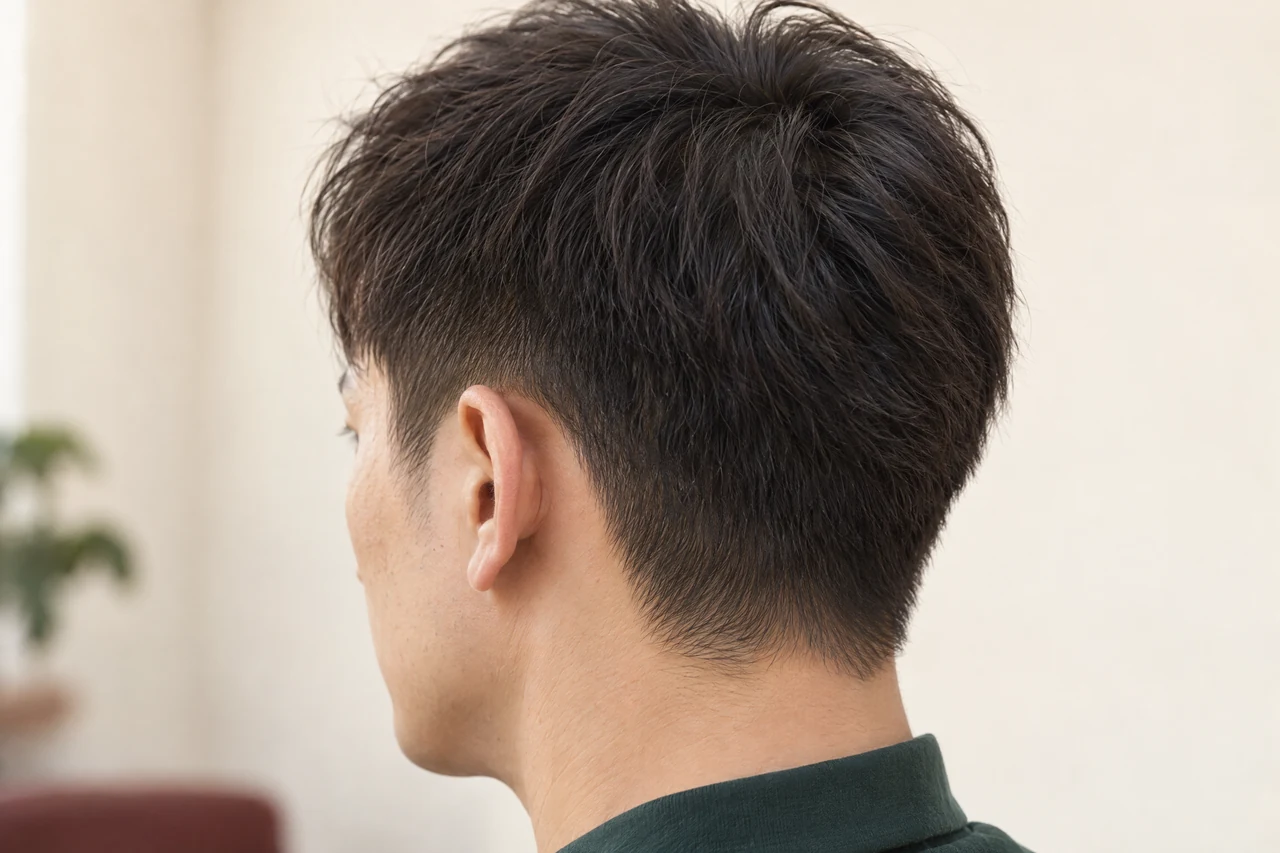
Choose fade-edge height without changing the shine brief
A fade's height changes how far the short-to-long transition travels up the sides. The edge around the ear is a different detail, and top shine is another. You can prefer a modest transition with a polished top, or stronger side contrast with a natural-looking top. Do not let a shiny reference photo decide how much side coverage you lose. Look specifically at the shortest area and at where the longer side hair begins.
DT HUB's fade haircut hong kong destination lists low, mid and high fades. Treat those names as the beginning of a discussion, not a complete set of instructions. Ask to see the proposed transition height on your own head and explain how much visible side coverage you want to retain. If you like your present cut and only want a different finish, say that clearly: a new product preference need not become a higher or shorter fade.
The Vit So fade haircut guide helps separate fade and taper structure when that terminology is unclear. Use it to settle the height and coverage question, then return to your finish brief. Ask how the retained side weight connects to the top when the hair is relaxed. Shortening the sides further is not a reliable answer to every complaint about a broad profile; the consultation should identify whether you are noticing the cut, the top's arrangement or both.
Add matte texture or shine only after the shape is agreed
Once the dry outline is acceptable, describe the surface finish in observable terms. ‘Matte’ might mean no obvious wet-looking reflection; ‘soft’ might mean strands remain movable; ‘polished’ might mean a controlled direction with visible shine. These descriptions are more useful than selecting by jar name alone. Ask about the actual product's hold, finish and application instructions, because products sold as paste, wax or pomade do not all behave identically. Start with a modest application suited to the product, then assess whether more is needed.
For a broader salon enquiry, DT HUB's kwun tong hair salon guide describes English consultation and multiple service categories. Keep your request focused on the haircut finish: ‘Can we discuss a dry, low-shine finish and pause before applying product?’ Ask whether a softer demonstration can replace the default styled look. This is a clarification of salon scope, not a reason to add colour, a perm or a scalp service when your concern is simply how the completed haircut is presented.
If the reference has a swept-back top, Vit So's slick back haircut guide explains the related length and direction choices. A softer swept-back version may suit someone who wants movement; a fixed, glossy version suits someone willing to arrange it more deliberately. Consider how you usually touch and reset your hair. The American Academy of Dermatology advises reducing long-lasting-hold products and warns that combing after applying them can cause breakage. Avoid repeatedly dragging a comb through a finish that has set. [1]
Drying technique also belongs in the finish discussion. The AAD recommends gently absorbing moisture rather than roughly rubbing hair, limiting excessive heat, and using low or medium heat settings with heat protection. [2] Ask for a demonstration compatible with those general precautions rather than hotter drying to force every section flat. These are ordinary care considerations, not evidence that a particular haircut or finishing product treats a hair or scalp condition.

Confirm the appointment and leave with a usable finish brief
Before visiting, send a concise description of your baseline and preferred finishing change. For example: ‘I want to retain my current length, check the dry side outline, then try a softer low-shine top.’ That is a proposed consultation brief, not a report of a real customer result. Include a current unstyled view alongside the reference if you are comfortable sharing one, and ask whether the appointment can cover the inspection and demonstration you need.
Use DT HUB's hair salon near kwun tong mtr contact page to confirm the arrival details: Room 03, 21/F, Lee Bo Times Centre, 50 Hoi Yuen Road, Kwun Tong, Kowloon. Its salon WhatsApp is 5562 9872. Confirm your appointment time and building access directly rather than relying on a walking estimate. This Kwun Tong address is distinct from Vit So's Sheung Wan location at 252 Hollywood Road; do not transfer a booking, quote or contact assumption between them.
Ask what the quotation includes and whether any requested detailing or extra styling demonstration changes the scope. Before leaving the chair, check the agreed dry outline and then the chosen product finish. If something feels too shiny or too rigid, describe that change while it can still be discussed. Leave knowing the usual drying direction and the product instructions you intend to follow. A useful completion standard is not a perfectly staged photograph; it is understanding the difference between your everyday baseline and your optional styled version.
Compare finish priorities without treating them as new haircut types.
| Priority | What to check before product | What to ask about finishing | Trade-off |
|---|---|---|---|
| Crisp side outline | Ear edge, sideburn endpoint and nape boundary | Keep top sheen a separate choice | A defined perimeter makes growth changes more noticeable |
| Softer dry finish | Natural fringe position and relaxed side width | Minimal visible shine and movable strands | Some natural movement remains |
| Matte textured top | Length and direction before separating strands | Product-specific hold with little wet-looking reflection | Matte appearance alone does not establish ease of restyling |
| Polished shiny top | Retained length and comfortable sweep direction | Desired gloss and a repeatable application method | More deliberate arrangement may be needed |
Your preparation checklist
- Name the main priority: side outline, softer resting shape or polished top.
- Show which reference feature you like and which you do not want copied.
- Say whether your usual routine is air-drying or blow-drying.
- Request a dry outline check before finishing product is applied.
- Agree separately on ear edges, neckline and fade height.
- Confirm the chosen product's finish, hold and application instructions.
- Confirm the correct location, appointment time and quotation scope.
Frequently asked questions
Can I ask for crisp sides with a soft top?
Yes. Explain the ear and neckline boundaries you want, then separately describe a top that is movable and not visibly wet-looking. Ask to inspect the outline first so that a soft product finish does not replace the edge discussion.
Does matte mean there is no product in the hair?
No. Matte describes an appearance, not the absence of product. If you want to see a product-free baseline, ask for that explicitly. Also check whether the shape shown has been created through blow-drying that you would need to repeat at home.
Should I request a shorter fade if the top looks too shiny?
Not for shine alone. First discuss a different finishing product or application. Change fade height only if you also want different side coverage or contrast; otherwise you may alter a haircut shape you already like.
What if I do not want any daily product styling?
Say so before cutting and ask which retained lengths can sit acceptably with your normal drying routine. You may need to accept natural movement or adjust the proposed length. A product-free salon finish is useful only if its preparation is realistic for you.
Bring a shape brief, not just a shiny reference
Choose the dry outline you want to approve, then describe your optional product finish. Ask your intended salon to confirm the consultation scope and quotation before booking. Keeping those decisions separate helps you discuss a change in finish without accidentally requesting a different haircut.
Start your WhatsApp enquirySources & further reading
- American Academy of Dermatology: Hair styling without damage
Avoid repeatedly combing through hair after a long-lasting hold product has set; reduce reliance on such products. This supports gentle styling only, not claims about a haircut or product’s efficacy.
- American Academy of Dermatology: Tips for healthy hair
Gently absorb moisture rather than rubbing; limit excessive heat and use low or medium settings with heat protection when blow-drying. Do not use a hotter finish to force the outline.



